


News&Blogs
Polymer sand tiles are a modern composite building material that has gained increasing attention in the global construction and landscaping market. Originally introduced as an alternative to traditional cement paving tiles, polymer sand tiles were developed to overcome common problems such as poor frost resistance, cracking, short service life, and surface dusting.
According to industry practice, polymer sand tiles combine natural sand and polymer materials through a thermal forming process. With growing demand for durable and environmentally friendly paving solutions, understanding what polymer sand tiles are and how they are produced has become increasingly important for investors, contractors, and beginners entering this field.
As an experienced plastic machinery manufacturer, Zhangjiagang Chenxing Machinery Co., Ltd. provides complete equipment solutions for polymer sand tile production and supports customers with full-process manufacturing systems.
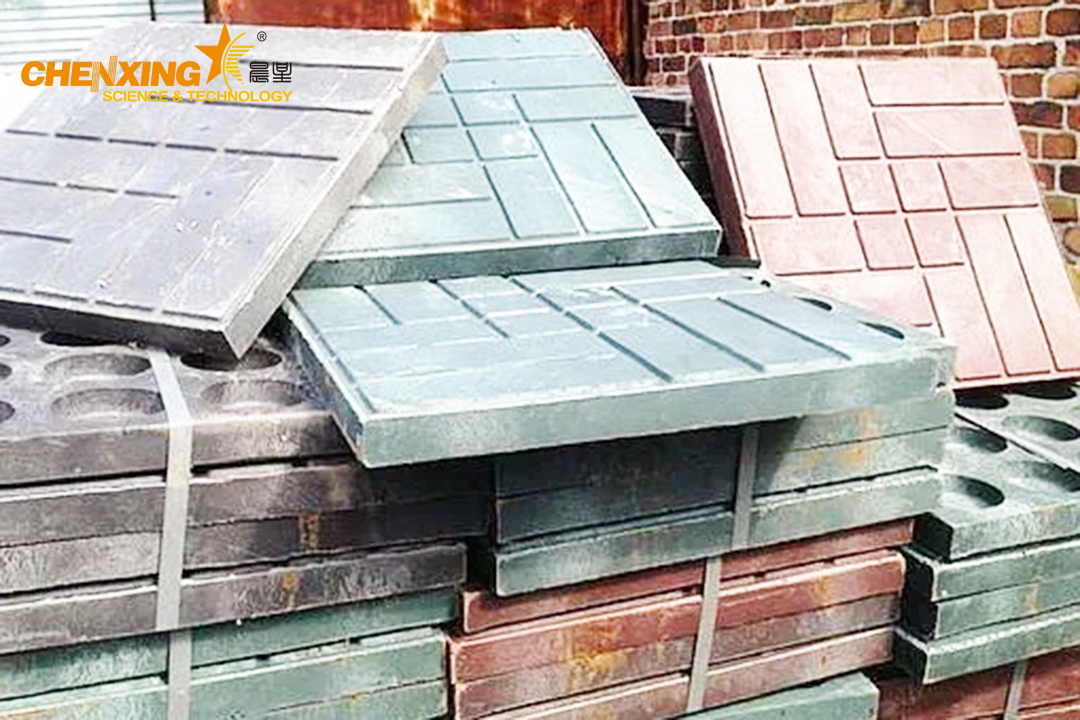
Polymer sand tiles are paving products made from a composite mixture of:
Sand (medium fraction, no more than 3 mm, without clay impurities)
Polymers, including primary polymers or recycled plastic materials
Inorganic mineral pigments
Sand is the main filler and accounts for approximately 70–75% of the total volume. Before use, sand must be washed, sieved, and dried to meet production standards. Polymers act as a binding component and can be produced from crushed or agglomerated plastic waste, which improves economic efficiency.
Unlike cement tiles, polymer sand tiles are not produced by hydration reactions. Instead, the material is heated, melted, and pressed, resulting in a dense and homogeneous internal structure without cracks or voids.
Based on documented performance data, polymer sand tiles offer several advantages compared to traditional concrete paving slabs:
High mechanical strength and resistance to point loads
Excellent frost resistance and moisture resistance
Stable performance under exposure to sunlight, oils, and acid-containing liquids
Long service life, typically around 30 years or more
Decorative flexibility in shape, texture, and color
Color stability over time due to full-depth pigmentation
Easy cleaning, repair, and repeated use
No emission of toxic fumes, even under high temperatures
These properties make polymer sand tiles suitable for use in gardens, courtyards, parks, garages, workshops, commercial areas, pedestrian zones, and operated flat roofs.
The production of polymer sand tiles requires strict control of raw materials:
Fraction size ≤ 3 mm
Free of clay and foreign inclusions
Moisture content ≤ 10% before processing
Primary or secondary polymers
Recycled plastic waste such as polyethylene products can be used
Plastics must be sorted, washed, dried, and crushed before use
Mineral or organic pigments
Added to achieve stable and long-lasting color
Proper preparation of raw materials directly determines the final quality of polymer sand tiles.
The manufacturing technology of polymer sand tiles is relatively simple but requires coordinated equipment and process control. The complete production process includes the following stages:
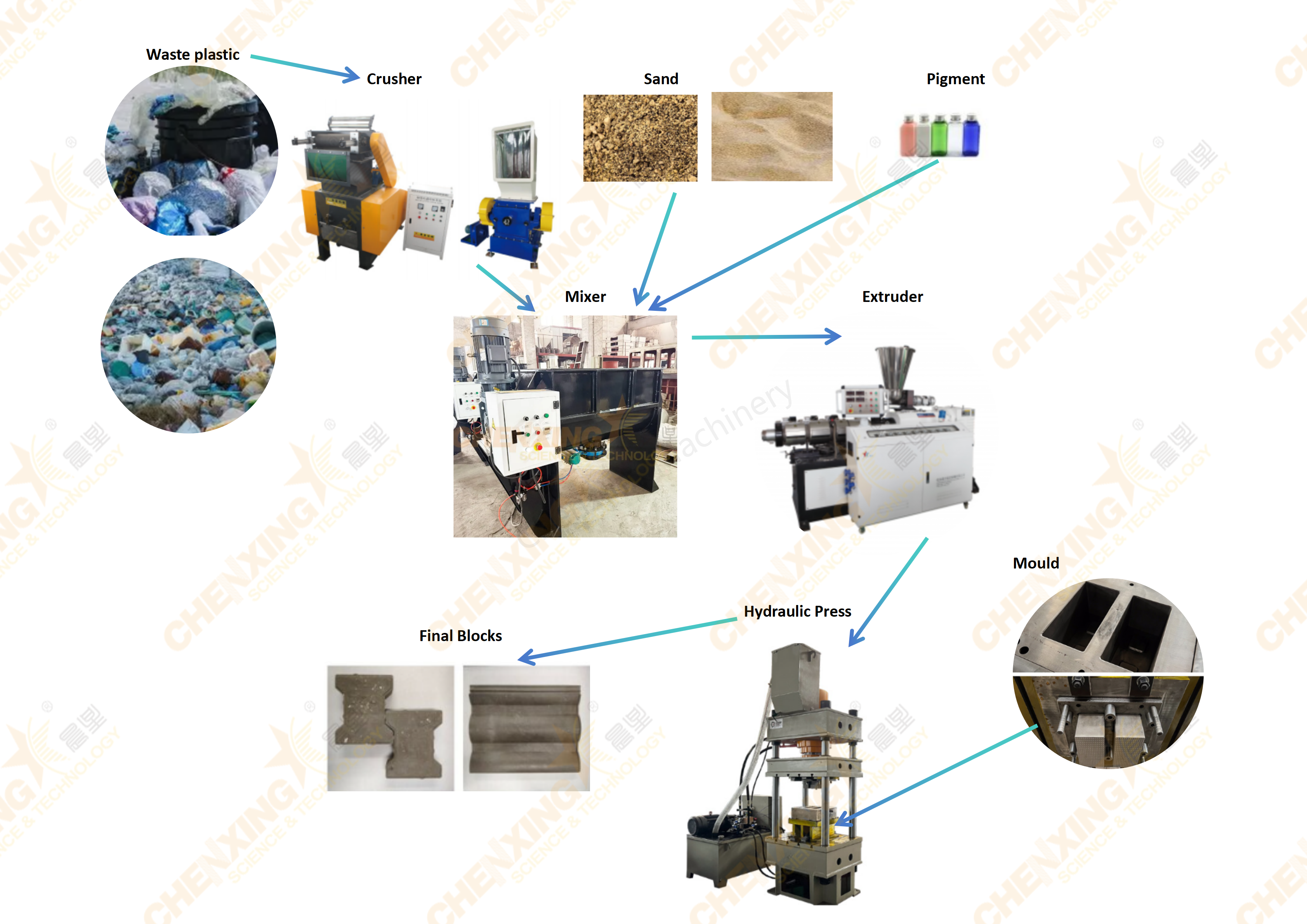
Plastic raw materials are crushed or agglomerated into uniform particles. This step may be omitted if ready-made polymer chips are used.
Sand, polymer particles, pigments, and additives are mixed thoroughly in an industrial mixer to ensure uniform distribution.
The mixed material is heated and melted in an extruder at a temperature of approximately 250°C, forming a homogeneous polymer-sand mass.
The hot material is transferred to a hydraulic press, where it is formed into tiles using molds under high pressure.
Finished tiles are cooled, packaged, and transferred to the warehouse for storage or shipment.
Modern automated equipment ensures that finished products are dense, uniform, and free from internal defects.
Common specifications include:
Tile size: 330 × 330 × 35 mm
Quantity: 9 tiles per square meter
Weight per tile: approximately 4 kg
Weight per square meter: approximately 36 kg
Under standard production conditions, a complete line can produce up to 140 m² of finished tiles per day, depending on mold capacity and operating shifts.
Polymer sand tiles can be laid on different bases depending on usage requirements:
Sand base for garden paths and pedestrian areas
Crushed stone base for areas with vehicle loads
Concrete base for heavy-duty applications
During installation, expansion gaps of at least 5 mm must be maintained to prevent deformation under high temperatures.
Based on the documented production technology, Chenxing Machinery is able to provide complete polymer sand tile production lines, including:
Plastic crushing systems
Sand drying and preparation equipment
Industrial mixing systems
Extrusion and heating units
Hydraulic molding presses
With integrated equipment design and manufacturing experience, Chenxing Machinery supports customers in building stable and efficient polymer sand tile production systems.
Q1:What are polymer sand tiles?
Polymer sand tiles are paving products made from a mixture of refined sand, polymer materials, and mineral pigments. They are formed through heating and compression molding instead of traditional cement hydration.
Q2:What raw materials are used to produce polymer sand tiles?
The main raw materials include sand with a particle size of no more than 3 mm, primary or recycled polymers, and inorganic or organic pigments. Sand typically accounts for about 70–75% of the total composition.
Q3:How are polymer sand tiles manufactured?
The production process includes polymer crushing or agglomeration, raw material mixing, melting the mixture in an extruder at around 250°C, compression molding with a press, and cooling and packaging.
Q4:What are the advantages of polymer sand tiles compared to concrete tiles?
Polymer sand tiles offer higher frost resistance, better durability, resistance to moisture and chemicals, long service life, stable color, and easier maintenance compared to traditional concrete paving slabs.
Q5:Where can polymer sand tiles be used?
They are commonly used in gardens, courtyards, parks, pedestrian areas, garages, workshops, parking areas, and other residential or commercial outdoor spaces.
Q6:Can recycled plastics be used in polymer sand tile production?
Yes. Secondary polymers made from recycled plastic waste can be used after proper sorting, cleaning, drying, and crushing, which improves economic efficiency.
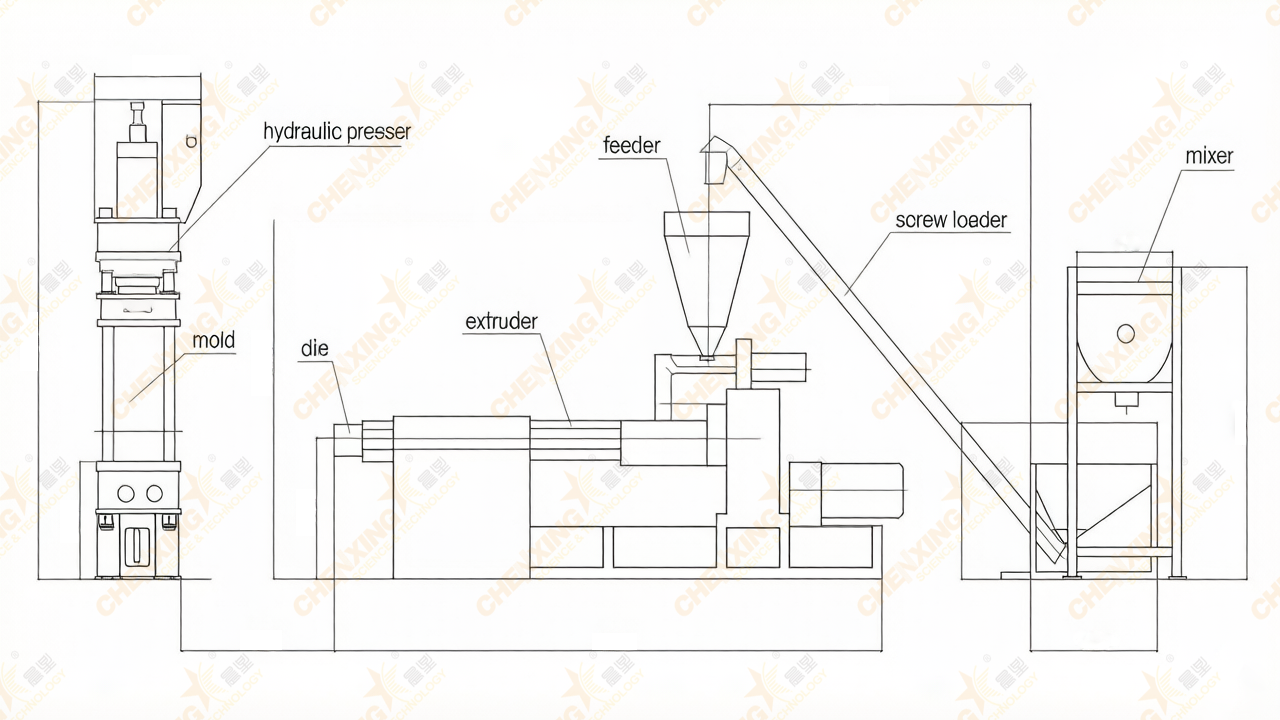
Q7:What equipment is required for polymer sand tile production?
A complete production line typically includes plastic crushing equipment, sand drying systems, industrial mixers, extruders for melting, and hydraulic presses for forming tiles.
Q8:Can Chenxing Machinery provide a complete polymer sand tile production line?
Yes. Chenxing Machinery supplies complete polymer sand tile production lines based on documented manufacturing technology, covering raw material preparation, mixing, heating, and molding processes.
Polymer sand tiles represent a practical, durable, and cost-effective paving solution with strong market demand. Their production process is based on proven technology and widely available raw materials, including recycled plastics.
For customers seeking to understand polymer sand tiles or plan a production project, Chenxing Machinery offers professional equipment solutions and complete production line support based on documented industry practices.


