


 |
| Quantity: | |||||||||
|---|---|---|---|---|---|---|---|---|---|
Product Description
Every plastic recycling line — bottle washing, film washing, flake cleaning — discharges water loaded with suspended solids, residues and chemical carryover. Sending that water to a drain untreated is increasingly impossible, and recycling it without proper treatment simply spreads the dirt back onto the flake. Producers who add a compact wastewater treatment stage turn a compliance cost into a closed-loop advantage.
Washed PET bottles, PP/PE film and HDPE flakes leave behind labels, fines and suspended matter. A treatment system that only settles the water still fails when the load is high; the answer is a staged process that coagulates, separates and filters before anything is discharged or reused.
Alkaline detergents and surfactants from the washing and recycling production line must be neutralized and flocculated before the water can re-enter the wash circuit. That is why the WT system adds acid and coagulants in controlled steps — not as an afterthought.
Fines and contaminants removed from wash water form sludge that is expensive to haul while wet. Dewatering it on site changes the economics of the whole plant.
In many regions fresh water is metered and scarce. A recycling line that treats and reuses its own water runs cheaper per kilogram of output — and passes environmental inspection with the same installation.
The Industrial Wastewater Treatment System / Plant (WT Series) treats wastewater from plastic recycling line sewage, domestic sewage, factory sewage and school sewage. It is a complete, packaged treatment train rather than a single filter, designed to sit beside the plastic recycling line solution and turn its process water into a reusable resource.
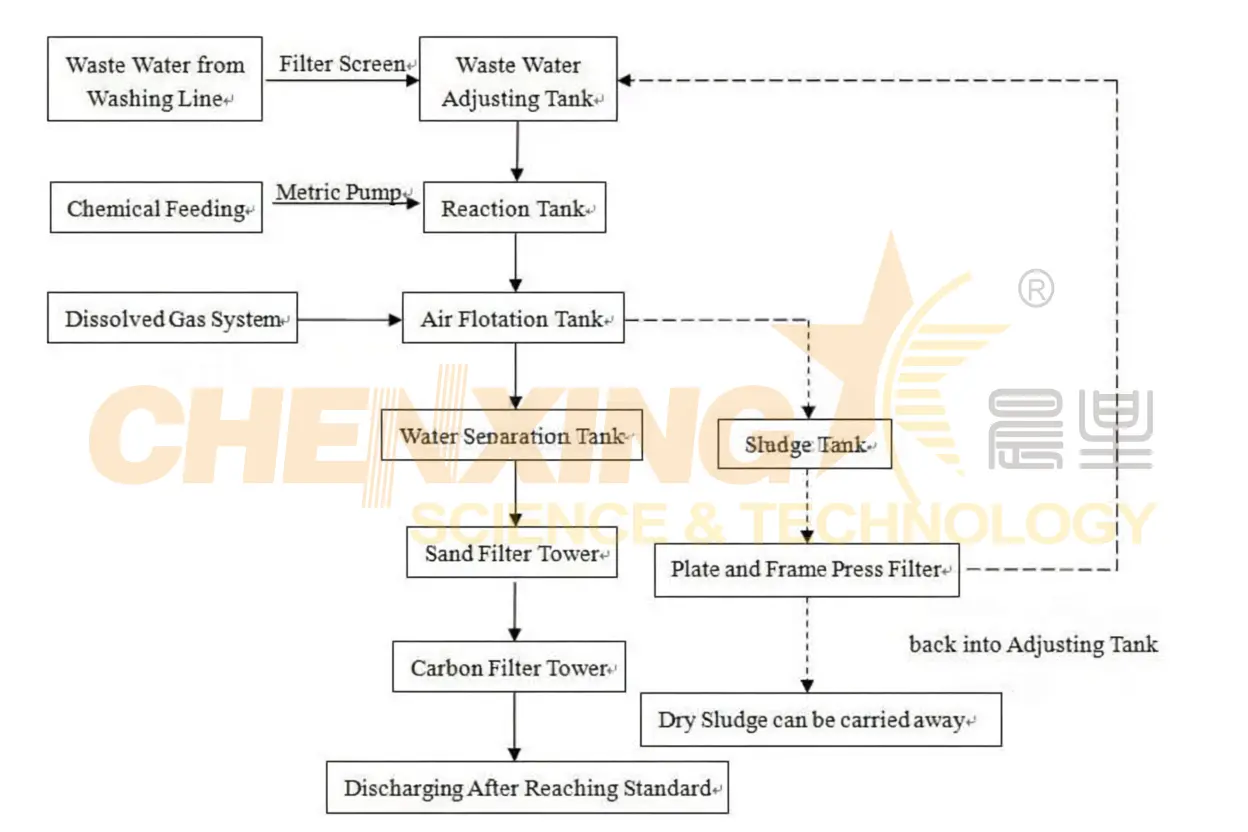
The main machine train includes: wastewater adjust pond, reaction tank, air flotation tank, separation water tank, sand filter tower, carbon filter tower, sludge tank and plate frame filter press.
Before the wastewater enters the treatment system, the user builds a big collection sump and adds a screen set to filter out residue. From the sump the water moves through conditioning, reaction, separation, sludge dewatering and final filtration — in that order — until the treated water is clean enough to drain out or use again.
A big sump gathers the line discharge, and a screen set removes coarse residue before the water reaches the treatment equipment. This first barrier protects every downstream stage from ragging and blockages.
The water enters the wastewater adjusting pond, where sulfuric acid and PAC are added to condition the pH and destabilize suspended particles. Correct adjustment at this stage decides how well the next flocculation step performs.
In the reaction tank, PAC and PAM are added to build flocs from the conditioned impurities. The flocs grow large enough for the following separation stage to catch them.
The flocculated water passes through the air flotation tank and the separation water tank, which separate water from impurities. The air flotation tank and filter tanks are made of stainless steel for durability and corrosion resistance in continuous service.
Separated sludge is collected in the sludge tank and solved by the plate frame filter press, which converts the sludge into dry form for easy removal or liquid recycling — no wet sludge hauling, no pooling.
The separated water is then polished through the sand filter tower and the carbon filter tower. After this final stage, the treated water can be drained out or used again — recycled back into the washing circuit or discharged to standard.
| Model | WT-5 | WT-10 | WT-15 | WT-20 |
|---|---|---|---|---|
| Capacity | 5 ton/h | 10 ton/h | 15 ton/h | 20 ton/h |
| Running Power | 13 kW | 21 kW | 24 kW | 26 kW |
| Labor Request | 1-2 worker | 1-2 worker | 2-3 worker | 3-4 worker |
| Line Dimension | 1165 m | 1365 m | 1675 m | 1975 m |
The WT train covers the full route in one system: adjust pond, reaction tank, air flotation, separation, sand filter, carbon filter and sludge press. Nothing is subcontracted to a second vendor; the process stages are matched to each other from day one.
The air flotation tank and filter tanks are made of stainless steel for durability and corrosion resistance, so the system keeps working in the humid, chemical environment of a wash plant.
Three PE barrels with individual pumps automatically adjust the pH to maintain the optimal reaction state, removing the guesswork from dosing and keeping flocculation consistent shift after shift.
The system is equipped with two independent pump sets to ensure non-stop system operation — if one pump needs service, the second keeps the treatment train running.
The plate frame filter press converts sludge into dry form for easy removal or liquid recycling, cutting disposal cost and keeping the plant floor clean.
Voltage options include 380V/50Hz 3-phase or customized specifications to match the local grid of your plant.
Every WT system carries a comprehensive 1-year warranty covering all mechanical equipment, supported by the Chenxing after-sales team.
The primary application: water from PET bottle, PE/PP film, HDPE bottle and flake washing loops. The WT system closes the loop on the washing line machines and the PET bottle crushing washing line.
Community and residential wastewater with organic and suspended loads can be conditioned through the same adjust-reaction-separation-filtration train.
General industrial process wastewater from factory operations, including rinse water and plant drainage, is treated with the standard WT configuration or a customized dosing plan.
Campus sewage with variable daily loads is handled by the WT-5/WT-10 sizes, which run economically at lower capacities while keeping full treatment quality.
Zhangjiagang Chenxing Machinery Co., Ltd. is a professional factory for plastic recycling and extrusion machinery with more than 20 years of experience, located in Zhangjiagang City, Jiangsu Province, China, exporting to 30+ countries. Chenxing's recycling family includes the two-stage recycling machine, PE/PP film recycling washing line, washing and recycling production line, plastic pelletizing line, agglomerator and auxiliary machines — and the WT wastewater treatment system completes the plant by handling the water side of the same process. See About Us or the full Products catalog.
The WT system treats plastic recycling line sewage, domestic sewage, factory sewage and school sewage. For recycling plants it is the natural partner of the washing line machines, treating wash water so it can be drained or reused.
The source process requires a big collection sump and a screen set before the water enters the treatment system, plus a concrete foundation sized to the WT model's line dimension. Chenxing provides the layout drawing for the selected model in the quotation stage.
Match the WT capacity (5/10/15/20 ton/h) to the maximum wastewater flow of your washing or production line. Tell us your daily water volume and your recycled-plastic output, and the engineering team will confirm the model.
A comprehensive 1-year warranty covers all mechanical equipment of the WT system, with responsive after-sales support from Chenxing engineers.
Yes. Voltage options are 380V/50Hz 3-phase or customized to your local grid, and the chemical dosing plan (sulfuric acid + PAC + PAM) can be adapted to your wastewater analysis.
Chenxing engineers guide the installation of the system and train your workers on operation, dosing control and routine maintenance. Contact Nicole from the contact page with your project details.
Yes. After sand and carbon filtration the treated water can be drained out or used again — recycled back into the washing circuit to cut fresh-water consumption, which is the configuration most recycling plants choose.
Start with three numbers: your line's maximum wash-water flow in ton/h, the available footprint, and your local discharge or reuse target. Chenxing will confirm the WT model, the layout, the dosing set and the delivery schedule in a written proposal.
Nicole — Email: ceo@cxsljx.com | Tel WeChat WhatsApp: +86 159 5118 7228
Send us your water source description or a simple flow figure; we reply with a recommended WT configuration within 24 hours. To study the plant layout and operation in more detail, view more machine details.


