


News&Blogs
The automated fluid dispensing systems market is racing toward $0.17 billion at 8.70% CAGR through 2035. Explore how semiconductor packaging, flip-chip underfill, and pharmaceutical sterile filling are driving precision micro-fluid dosing innovation.

While the broader dosing systems market captures headlines with its $9.15 billion trajectory, a specialized segment is experiencing even more explosive growth. The automated fluid dispensing systems market — focused on ultra-precise micro-fluid applications — is racing toward $0.17 billion at an 8.70% CAGR through 2035. The driving forces: semiconductor packaging miniaturization and pharmaceutical sterile filling requirements that demand accuracy at scales unimaginable a decade ago.
Industry leaders including Nordson, Graco, and Musashi Engineering have invested heavily in this space, but the underlying precision technologies are now cascading into industrial manufacturing applications where micro-liter accuracy creates macro-level competitive advantage.
Semiconductor packaging has become the defining precision challenge of modern manufacturing. Flip-chip underfill — the process of injecting micro-liter quantities of encapsulant between a chip and substrate — demands dispensing accuracy measured in nanoliters. A single void or inconsistency can render a multi-thousand-dollar chip unusable.
The precision technologies developed for this application — including advanced flow metering, pressure-compensated dispensing, and real-time weight verification — directly inform the design of industrial liquid dosing systems. For plastic compounders and cable manufacturers, this technology transfer means access to dosing precision previously reserved for the world's most demanding cleanroom environments.
India's Production-Linked Incentive (PLI) scheme is actively attracting sterile filling equipment investment, reshaping the global pharmaceutical manufacturing map. This government-backed initiative is creating new demand for high-precision dosing equipment that can meet pharmaceutical-grade standards at competitive price points.
For Chenxing Machinery, with its established presence in Asia-Pacific markets and custom engineering capabilities, this represents a significant growth vector. The company's PLC-based automation platform, featuring optional Schneider and Siemens components with CE safety certification, aligns with the quality and reliability expectations of pharmaceutical-adjacent manufacturing.

The European Union's REACH regulation continues to tighten chemical substance requirements, creating cascading compliance obligations throughout global supply chains. Contract packaging operations — which handle diverse chemical formulations across multiple clients — face particularly acute pressure to demonstrate precise, documented, and traceable fluid dispensing.
Key compliance capabilities of modern automated dispensing systems:
Formula Management: Store and recall multiple production recipes with complete version control
Batch Traceability: Automatic recording of batch quantity, date, time, formula, operator, and consumption data
Cross-Contamination Prevention: Automated cleaning cycles and dedicated flow paths for incompatible chemicals
Regulatory Documentation: Export-ready production records formatted for REACH, FDA, and other regulatory submissions
The electronics PCB manufacturing sector represents a rapidly growing application for precision fluid dispensing. Conformal coating, solder paste application, and adhesive dispensing all require micron-level accuracy to ensure product reliability. An 8.70% CAGR suggests this segment will more than double in value over the next decade — driven by electric vehicle electronics, 5G infrastructure, and IoT device proliferation.
For plastic extrusion manufacturers supplying the electronics industry — producing cable compounds, connector housings, and insulating materials — this growth translates directly to demand for higher-precision additive dosing in their own production processes.
The growth is driven by three converging factors: semiconductor packaging miniaturization requiring nanoliter dispensing accuracy, pharmaceutical sterile filling automation driven by regulatory requirements and India's PLI scheme, and electronics PCB manufacturing expansion fueled by EV, 5G, and IoT demand.
Precision technologies developed for semiconductor applications — including advanced flow metering, pressure-compensated dispensing, and real-time weight verification — are being adapted into industrial dosing systems that serve PVC extrusion, compounding, and recycling applications.
Chenxing Machinery provides precision liquid dosing systems with stainless steel construction options, PLC control, complete data traceability, and customizable configurations suitable for pharmaceutical-adjacent manufacturing and high-purity industrial applications.
REACH (Registration, Evaluation, Authorisation and Restriction of Chemicals) is the EU's chemical safety regulation. It requires manufacturers to demonstrate precise control, documentation, and traceability of chemical substances used in production — capabilities that automated metering systems deliver natively through digital batch recording and formula management.
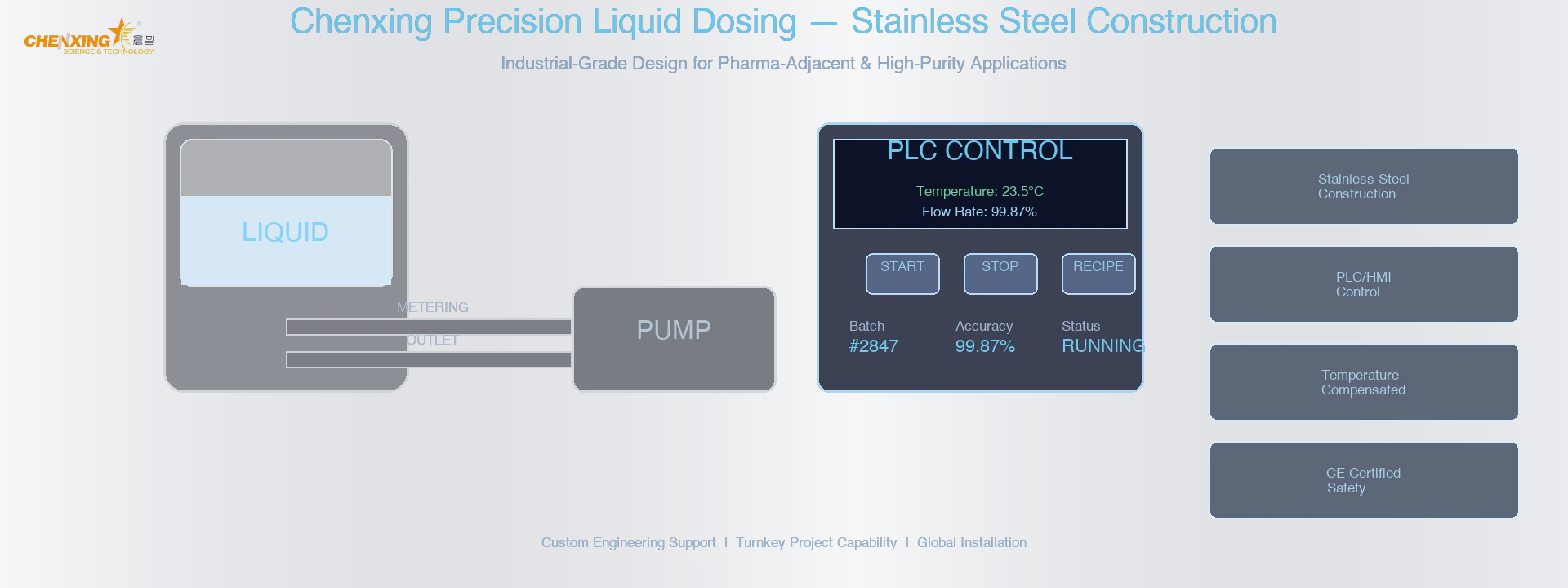
The $0.17 billion automated fluid dispensing market rewards manufacturers who invest early in precision capability. Chenxing Machinery bridges the gap between semiconductor-grade precision and industrial-scale production with customized liquid dosing solutions that deliver measurable quality improvements and regulatory compliance. Serving 30+ countries with turnkey project support, our team is ready to engineer your precision advantage.
Explore Precision Dosing Solutions →


