


News&Blogs
In plastic processing and recycling industries, pelletizing technology directly affects pellet uniformity, production efficiency, and downstream extrusion performance.
For PVC and heat-sensitive materials, the Hot Cutting Pelletizing Line—also known as a Mould-Face Cutting Pelletizing Line—is widely recognized as one of the most efficient and precise pelletizing solutions.
This article explains what a hot cutting pelletizing line is, how it works, its technical parameters, applications, and why it is especially suitable for PVC pellet production.
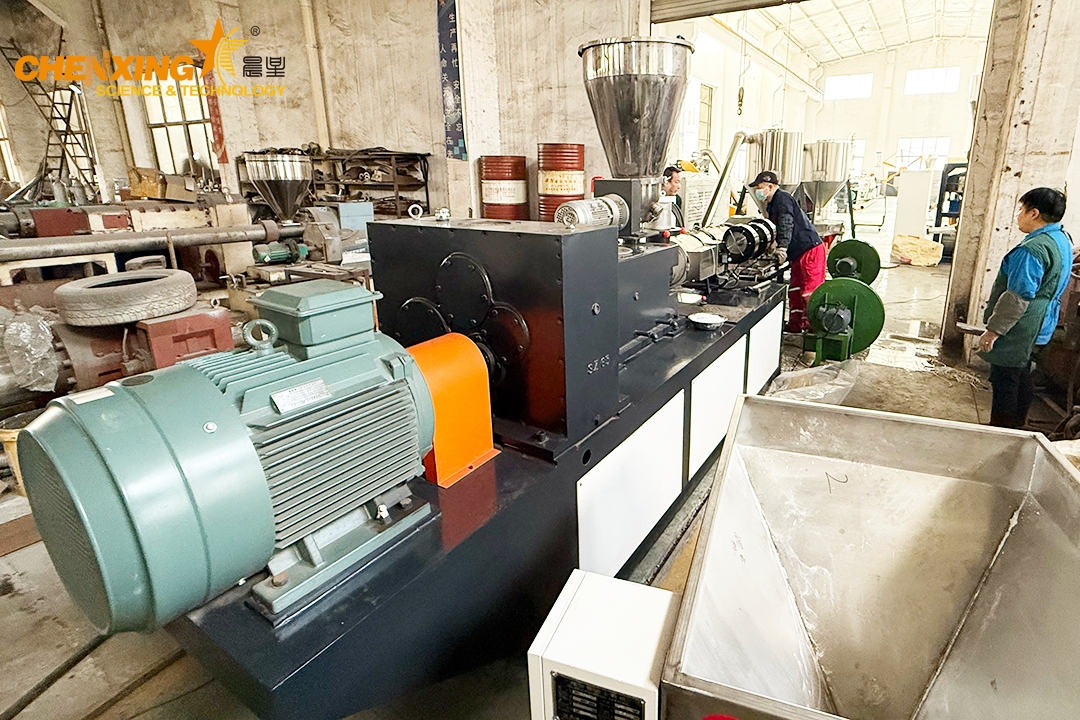
A Hot Cutting Pelletizing Line is a pelletizing system in which molten plastic is cut directly at the die face before cooling, producing uniform pellets with high dimensional accuracy.
Unlike water strand pelletizing, cutting occurs immediately after extrusion, eliminating the need for strand cooling and drying systems.
This system is mainly used for:
PVC pelletizing
PVC compound production
PVC hot-cut granulation
Certain heat-stable thermoplastics
Based on the equipment shown in the uploaded image, a typical PVC hot cutting pelletizing line consists of:
Specially designed for PVC processing, the conical twin screw extruder ensures stable plasticization and consistent melt pressure.
A high-speed rotating cutter cuts molten plastic directly at the die surface, producing smooth and uniform granules.
Pellets are cooled naturally or via air cooling and collected immediately after cutting.
Integrated control panel allows precise regulation of cutting speed, extrusion temperature, and output stability.
The working process includes:
PVC powder feeding
Plasticization in twin screw extruder
Melt extrusion through die
Mould-face hot cutting
Pellet cooling
Pellet collection
This direct cutting process significantly improves pellet consistency and production efficiency.
| Model | SJSZ80 | SJSZ65 | SJSZ51 |
|---|---|---|---|
| Installed Power (kW) | 55 | 37 | 15 |
| Production Capacity (kg/h) | 350–500 | 250–300 | 100–120 |
| Granule Diameter | Φ3 mm | Φ3 mm | Φ3 mm |
| Total Line Length (m) | 15 | 15 | 12 |
These specifications make the line suitable for small, medium, and industrial-scale PVC pellet production.
Mould-face cutting ensures uniform pellet diameter and smooth pellet surface.
Continuous hot cutting allows stable, uninterrupted pelletizing.
Compared with water strand pelletizing systems, hot cutting lines require less floor space.
Especially suitable for PVC compounds that are difficult to strand-cut due to melt behavior.
Modular structure enables quick installation and convenient relocation.
Used for cable PVC, pipe-grade PVC, and profile-grade PVC pellets.
Suitable for re-pelletizing clean PVC materials.
Capable of producing color masterbatch pellets with high consistency.
Ideal for companies that require stable pellet quality for downstream extrusion lines.
| Aspect | Hot Cutting Pelletizing | Water Strand Pelletizing |
|---|---|---|
| Cutting Position | Die face (hot) | After cooling |
| Pellet Uniformity | Very high | High |
| Floor Space | Compact | Larger |
| PVC Compatibility | Excellent | Limited |
| Maintenance | Simple | Moderate |
Hot cutting pelletizing lines are mainly used for PVC and PVC compounds, but can also process certain stable thermoplastics.
PVC melt does not form stable strands easily. Hot cutting at the die face avoids strand breakage and ensures uniform pellets.
Standard pellet diameter is Φ3 mm, adjustable according to die and cutter configuration.
Depending on model, output ranges from 100 kg/h to 500 kg/h.
Yes. Extruder size, cutting system, pellet diameter, and automation level can be customized based on customer requirements.
Chenxing Machinery specializes in PVC pelletizing solutions, offering:
Mature conical twin screw extrusion technology
High-precision mould-face cutting systems
Stable electrical and temperature control
Custom-engineered pelletizing lines
We provide complete support including:
Pelletizing line design
Installation and commissioning
Operator training
Long-term technical service
Looking for a PVC hot cutting pelletizing line manufacturer or mould-face cutting pelletizing system supplier?
Visit www.chenxingmachinery.com
Contact our technical team for customized pelletizing solutions and competitive quotations.


