


News&Blogs


In plastic manufacturing, the consistency of raw material feeding has a direct impact on production stability, material consumption and finished-product quality.
Whether a factory produces PVC pipes, plastic profiles, plastic compounds or recycled pellets, the production process often requires several materials to be supplied in specific proportions.
These materials may include:
Virgin plastic resin
PVC resin powder
Calcium carbonate and other mineral fillers
Stabilizers and processing additives
Color masterbatch
Recycled plastic materials
Other formulation ingredients
Manual weighing and material feeding can increase operator workload and introduce variations between batches, especially when multiple ingredients and frequent formulation changes are involved.
An automatic weighing and metering system helps control the quantity or proportion of each material through weighing devices, feeding mechanisms and a control system.
Depending on the production requirements, it can operate independently or be integrated with material conveying, mixing and centralized feeding equipment.
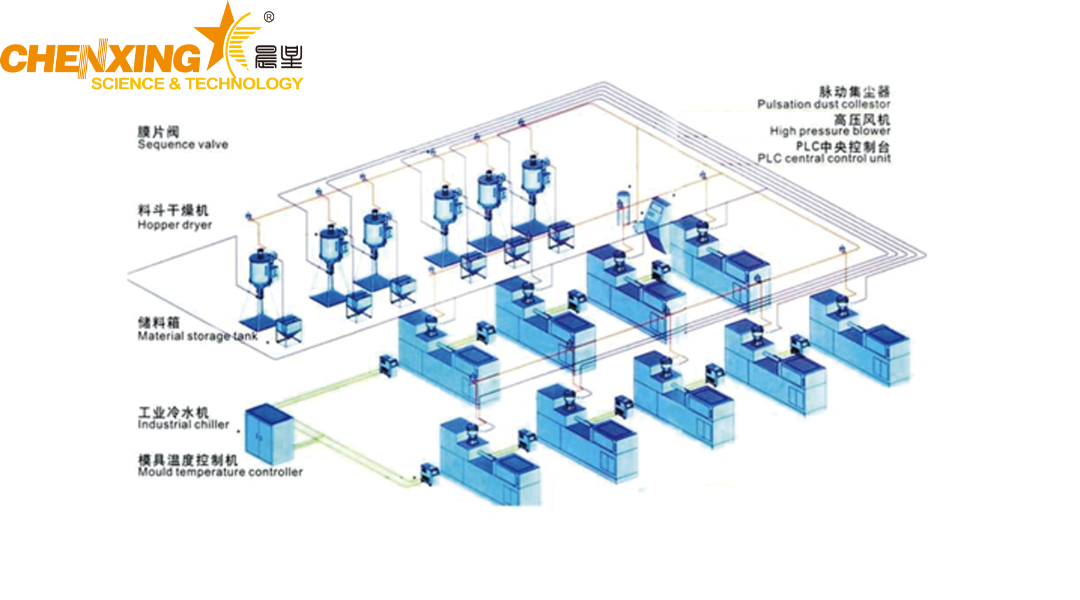
An automatic weighing and metering system is industrial equipment designed to measure, control and deliver raw materials according to predefined weight or proportion requirements.
It is commonly used in plastic compounding, PVC mixing, extrusion production and other manufacturing processes involving multiple ingredients.
A typical system may consist of:
Raw material storage hoppers or silos
Weighing hoppers and load cells
Screw feeders or pneumatic feeding devices
Weighing controllers
PLC control cabinet
Mixing equipment
Screw or pneumatic conveying equipment
The exact configuration depends on the material characteristics, required batching method, production capacity and downstream equipment.
For example, a PVC compounding project may require the system to weigh PVC resin, calcium carbonate and different additives according to a specified formulation before transferring the materials to a mixer.
The purpose is to make material preparation more consistent and reduce dependence on manual weighing and feeding.
The working process varies according to whether the system uses batch weighing or continuous gravimetric feeding.
Different materials are stored in separate hoppers, silos, bins or feeding stations.
The storage arrangement depends on material type, bulk density, required storage volume and factory layout.
For powders that may bridge or adhere to hopper walls, suitable hopper geometry and discharge assistance should be considered.
The selected material is transferred toward the weighing unit through a feeding mechanism.
Common feeding methods include:
Screw feeding
Pneumatic conveying
Gravity feeding
Vibratory feeding
The feeding method should match the material's flow characteristics.
For example, screw feeders are commonly used for powders and granules, while pneumatic conveying can be used to transfer suitable bulk materials through pipelines.
The weighing system measures the quantity of material through load cells and weighing instruments.
For a batch weighing system, material enters a weighing hopper until the target weight is reached.
The weighing controller receives the load-cell signal and compares the measured weight with the preset target.
For continuous gravimetric feeding, a loss-in-weight feeder measures the reduction in material weight over time to calculate and regulate the feeding rate.
These two methods serve different production requirements and should not be confused.
The control system coordinates the feeding and weighing sequence according to the required formulation.
For example, a PVC dry blend may contain several ingredients with different target weights.
The system can be programmed to feed each ingredient according to its specified quantity before transferring the weighed materials to the next process.
Depending on the control configuration, operators may be able to enter or select different batching parameters through an HMI.
After the required weight or proportion has been reached, the material is discharged into a mixer, blending unit or designated conveying system.
For PVC processing, a high-speed hot mixer and a cooling mixer may be integrated after the weighing stage to prepare the PVC dry blend.
For other plastic compounding applications, the downstream equipment can be selected according to the material and processing requirements.
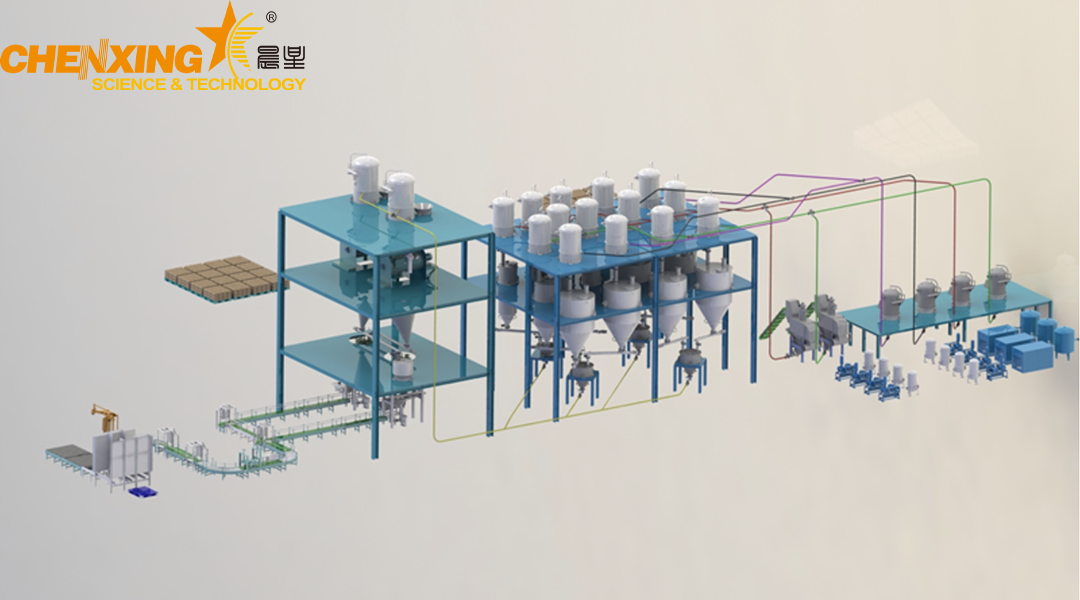
Different manufacturing processes require different weighing methods.
A batch weighing system measures a predetermined quantity of material for each production batch.
The system normally uses a weighing hopper, load cells, a feeding mechanism and a weighing controller.
Once the target weight is reached, the material is discharged and the next ingredient can be weighed.
Typical applications:
PVC raw material batching
Plastic powder mixing
Mineral filler dosing
Multi-ingredient compounding
Industrial powder blending
Batch weighing is suitable when materials need to be prepared according to a fixed formulation before mixing or further processing.
A loss-in-weight feeder measures the reduction in material weight inside a hopper over time.
By calculating the weight loss per unit of time, the system determines the actual material feeding rate.
The controller can adjust the feeder output to maintain the required mass flow rate.
This method is commonly used when continuous and controlled material feeding is required.
Typical applications:
Plastic extrusion
Polymer compounding
Masterbatch production
Additive feeding
Continuous blending processes
Loss-in-weight feeding is particularly useful when the production process requires a controlled mass flow rather than a fixed batch quantity.
A volumetric feeder supplies material according to the volume delivered over a period of time.
Screw speed or another feeding mechanism controls the material output.
Unlike gravimetric feeding, volumetric feeding does not directly measure the actual material mass continuously.
Its accuracy can be affected by bulk density, particle size, material flowability and changes in feeding conditions.
Volumetric feeding can be suitable for applications where material properties remain relatively stable and the required dosing precision is compatible with the process.
A multi-ingredient batching system combines several weighing and feeding units under a coordinated control system.
Each ingredient is supplied according to its target weight or proportion.
The weighed materials can then be transferred to a centralized mixing unit or designated production equipment.
This arrangement is especially useful for PVC compounding and other formulations involving resin, fillers and additives.
Automatic weighing and central feeding are often discussed together in plastic manufacturing, but they perform different functions.
A central feeding system focuses on material storage, transportation and distribution. An automatic weighing and metering system focuses on measuring material quantities and controlling feeding proportions.
| Comparison | Automatic Weighing & Metering System | Central Feeding System |
|---|---|---|
| Main Function | Measures and controls material quantities | Stores, transports and distributes materials |
| Main Objective | Accurate dosing and batching | Stable material supply to production machines |
| Typical Equipment | Weigh hoppers, load cells, feeders, controllers | Silos, vacuum loaders, pumps, pipelines, filters |
| Material Control | Weight or feeding rate | Material transfer and supply |
| Typical Application | PVC batching and plastic compounding | Multi-machine material supply |
| Main Benefit | More consistent material proportions | Centralized material handling and reduced manual transport |
These systems are not mutually exclusive.
A factory can use central storage and vacuum conveying to distribute raw materials, while automatic weighing units measure the required quantities before mixing or feeding individual production machines.
For larger factories, combining material storage, conveying, weighing, mixing and distribution can provide a more integrated production arrangement.
Automatic feeding and automatic weighing are also different functions.
An automatic feeding system moves material from one location to another according to a control sequence.
An automatic weighing system measures how much material is supplied.
For example, a vacuum loader can automatically transfer plastic granules from a storage container to an extrusion machine hopper. However, unless a weighing or gravimetric feeding module is installed, the vacuum loader does not necessarily measure the exact mass of material delivered.
Similarly, a screw feeder can deliver material at a controlled screw speed, but it is not automatically a gravimetric system unless weight feedback is incorporated.
For this reason, buyers should evaluate feeding, weighing and mixing functions separately when specifying an automated material handling project.
PVC pipe and profile manufacturing often involves multiple raw materials, including PVC resin, stabilizers, lubricants, processing aids and mineral fillers.
An automatic weighing and batching system can measure these ingredients according to the required formulation before transferring them to the mixing unit.
This helps standardize material preparation between batches.
Plastic compounding involves combining polymer resins with fillers, additives, pigments and other functional materials.
Accurate ingredient proportioning is important because changes in formulation can influence processing behavior and finished-product properties.
Automatic gravimetric or batch weighing systems can be selected according to whether the process requires continuous feeding or batch preparation.
Recycling and pelletizing operations may involve virgin resin, recycled pellets, additives, color masterbatch and other compatible materials.
An appropriate weighing and feeding arrangement can help control the material proportions before extrusion or compounding.
The system should be selected according to the characteristics of the recycled material, including particle size, bulk density and flowability.
Masterbatch production requires controlled feeding of polymer carriers, pigments and functional additives.
Multi-ingredient weighing and gravimetric feeding systems can be considered depending on the required production process and material flow characteristics.
The weighing hopper receives the material, while load cells convert the applied weight into electrical signals.
The weighing controller processes these signals to determine the measured quantity.
The hopper capacity, load-cell range, mounting structure and installation conditions should be selected according to the required weighing range and material properties.
A screw feeder controls material delivery through screw rotation.
It is commonly used for powders, granules and other bulk materials.
Variable-frequency control can be used to adjust screw speed. When combined with suitable weight feedback, the feeding system can support gravimetric control.
Pneumatic conveying transfers suitable materials through pipelines using air movement.
It can connect storage silos, feeding stations, weighing units and mixing equipment.
The conveying method and pipeline design should be matched to material characteristics, conveying distance and required throughput.
A PLC coordinates the operation of feeding devices, weighing instruments, valves, motors and other connected equipment.
Depending on the software configuration, the system may support automatic batching sequences, operating parameter settings, alarms and manual/automatic mode switching.
An HMI provides an operator interface for setting parameters and monitoring the system.
Recipe storage, batch reports, user permissions and historical data functions depend on the actual control software and configuration.
Automated weighing helps reduce variations caused by manual measurement and feeding.
The actual result depends on the weighing method, equipment configuration, material properties and calibration.
Automatic feeding and batching can reduce repetitive weighing and material transfer work.
This may help improve production organization and reduce operator workload.
When recipe storage and selection functions are configured, operators can use predefined material quantities and batching parameters for different products.
This helps standardize production procedures.
By measuring material quantities, manufacturers can better monitor raw material usage and identify deviations from target formulations.
Actual material savings depend on the previous feeding method, process control and production conditions.
Automatic weighing systems can be integrated with high-speed mixers, cooling mixers, compounding equipment and other downstream units.
The complete configuration should be designed around the material preparation process.
Before purchasing an automatic weighing and metering system, manufacturers should evaluate several key factors.
Identify whether the system will process powders, granules, pellets, flakes or additives.
Bulk density, particle size, moisture, flowability and material adhesion can influence hopper and feeder design.
Determine whether the process requires batch weighing, continuous loss-in-weight feeding or volumetric feeding.
The weighing method should match the production process rather than being selected only by the equipment price.
Specify the number of materials that need to be weighed and the required proportions.
This information helps determine the number of storage units, feeders and weighing modules.
Provide the target batch weight, batches per hour or continuous feeding rate.
These values are important for selecting the hopper capacity and feeder size.
Confirm whether the system will supply a high-speed mixer, cooling mixer, extruder, compounding line or another production unit.
Specify whether the project requires PLC control, HMI operation, recipe storage, batch records, alarms or integration with existing factory systems.
Not every application requires all these functions.
Gravimetric feeding controls material supply based on weight measurement. Volumetric feeding controls material supply based on volume or feeder output.
Gravimetric feeding directly accounts for mass, while volumetric feeding can be influenced by changes in bulk density and material flow characteristics.
Yes, suitable configurations can be designed for powders, pellets and granules. However, hopper geometry and feeding mechanisms should be selected according to material flowability, particle size and bulk density.
Yes. The two systems can be integrated. Central feeding supplies and distributes materials, while the weighing system measures and controls the required quantities.
Yes. An automatic batching system can be arranged to weigh PVC resin, fillers and additives before transferring them to the hot and cold mixing unit.
The feeding sequence and discharge arrangement should be designed according to the mixing process.
No. Basic systems may only provide weighing and feeding control. Recipe storage, batch data recording, user permissions and production reports depend on the control hardware and software configuration.
Accuracy depends on the load cells, weighing controller, hopper structure, feeder design, material characteristics, installation conditions and calibration.
Buyers should request the actual weighing accuracy under specified operating conditions rather than relying on a general accuracy claim.
Yes. The system layout can be evaluated according to the existing storage equipment, feeding routes, mixers, production machines and factory space.
Chenxing Machinery supplies automated material weighing, batching, mixing and conveying equipment for plastic processing applications.
For PVC production, the system can be configured to handle PVC resin powder, fillers and additives before mixing and extrusion.
Depending on the project, the equipment may include:
Material storage and feeding units
Automatic weighing modules
Screw or pneumatic feeding devices
PLC-based control cabinet
High-speed hot mixer
Cooling mixer
Screw or pneumatic conveying equipment
The system configuration is determined by the material properties, production capacity, batching requirements and downstream equipment.
For manufacturers planning to automate raw material preparation, Chenxing can evaluate the required weighing, mixing and conveying arrangement according to the factory layout and production process.
To help us evaluate your project, please provide:
Material types: PVC powder, plastic pellets, fillers, additives or recycled materials
Number of ingredients
Target weight or proportion for each material
Required batch capacity or continuous feeding rate
Weighing method preference, if known
Existing mixer or extrusion equipment
Required automation functions
Factory layout and destination country
Contact Chenxing Machinery to discuss an automatic weighing, batching and conveying solution for your production line.
WhatsApp / WeChat: +86 15951187228
Email: ceo@cxsljx.com


