


 |




| Quantity: | |||||||||
|---|---|---|---|---|---|---|---|---|---|
Product Description
PVC ceiling and wall panels have captured over 40% of interior finishing market share in residential and commercial construction across Asia, the Middle East, and Africa — driven by their moisture resistance, termite-proof nature, and 30–50% lower installed cost compared to gypsum or aluminum alternatives. The Chenxing SJSZ-series PVC Ceiling & Wall Panel Extrusion Line is engineered as a versatile, high-output production platform capable of manufacturing ceiling panels, wall panels, U-clips, flooring planks, and decorative trim profiles from a single extruder by simply swapping the die head and calibration tooling. With optional on-line hot stamping for integrated woodgrain/marble decoration or off-line lamination for metallic and high-gloss finishes, this line delivers a complete ceiling-and-wall solution from raw material to finished, decorated panel in one continuous workflow.
| Model | SJSZ51/105 | SJSZ55/110 | SJSZ65/132 | SJSZ80/156 |
|---|---|---|---|---|
| Extruder Type | Conical Twin-Screw | Conical Twin-Screw | Conical Twin-Screw | Conical Twin-Screw |
| Screw Diameter (mm) | 51/105 | 55/110 | 65/132 | 80/156 |
| Main Motor Power (kW) | 18.5 | 22 | 37 | 55 |
| Max Output (kg/h) | 80–120 | 120–180 | 180–280 | 280–450 |
| Panel Width Range (mm) | 100–250 | 150–350 | 200–500 | 250–600 |
| Panel Thickness (mm) | 5–12 | 5–12 | 5–15 | 6–18 |
| Line Speed (m/min) | 0.5–2.5 | 0.5–3.0 | 0.5–3.5 | 0.8–4.0 |
| Vacuum Pump (kW) | 2×2.2 | 2×2.2 | 3×2.2 | 4×3.0 |
| Calibration Table Length (mm) | 3000 | 4000 | 5000 | 6000 |
| Total Line Length (m) | 15–18 | 18–22 | 22–26 | 26–30 |
Note: For panels exceeding 500 mm in width, the SJSZ80/156 model is recommended to ensure adequate melt strength and calibration vacuum uniformity across the full profile cross-section.
| # | Machine | Qty | Key Specifications |
|---|---|---|---|
| 1 | Screw Feeder | 1 set | Variable-speed spiral feeder; prevents bridging of powder blends; hopper capacity 200–500 L |
| 2 | SJSZ Conical Twin-Screw Extruder | 1 set | Bimetallic barrel, 38CrMoAlA nitrided screw (variable pitch/depth), Siemens/ABB motor, NSK gearbox with imported thrust bearings, oil + forced-air cooling, PID multi-zone ±1°C |
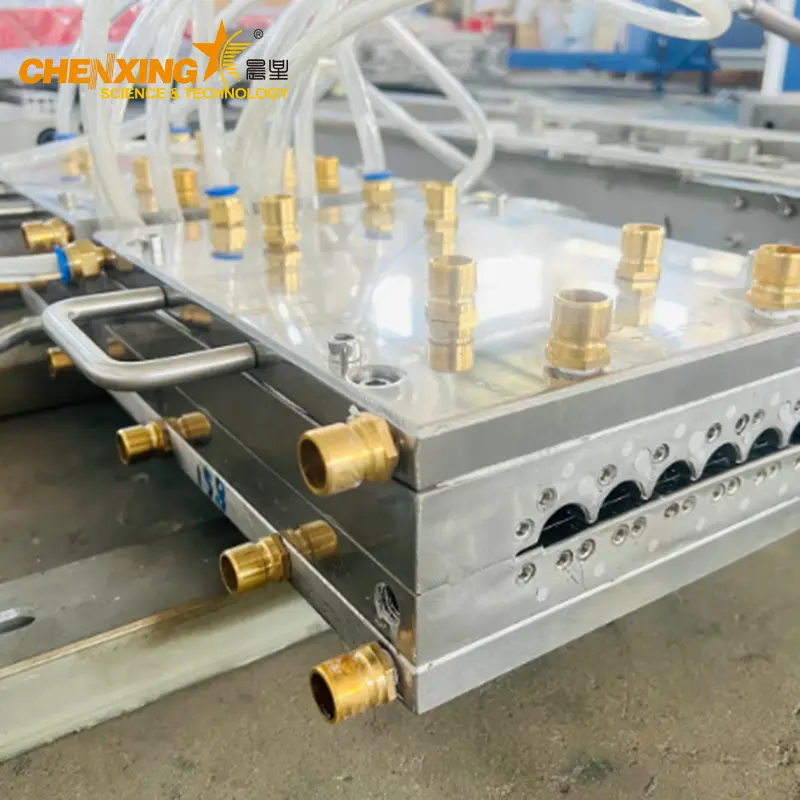
| 3 | Sheet/Profile Die Head | 1 set | 40Cr alloy steel, hard-chrome-plated flow channels, coat-hanger or T-die configuration (panel-width dependent), independently controlled multi-zone heater bands |
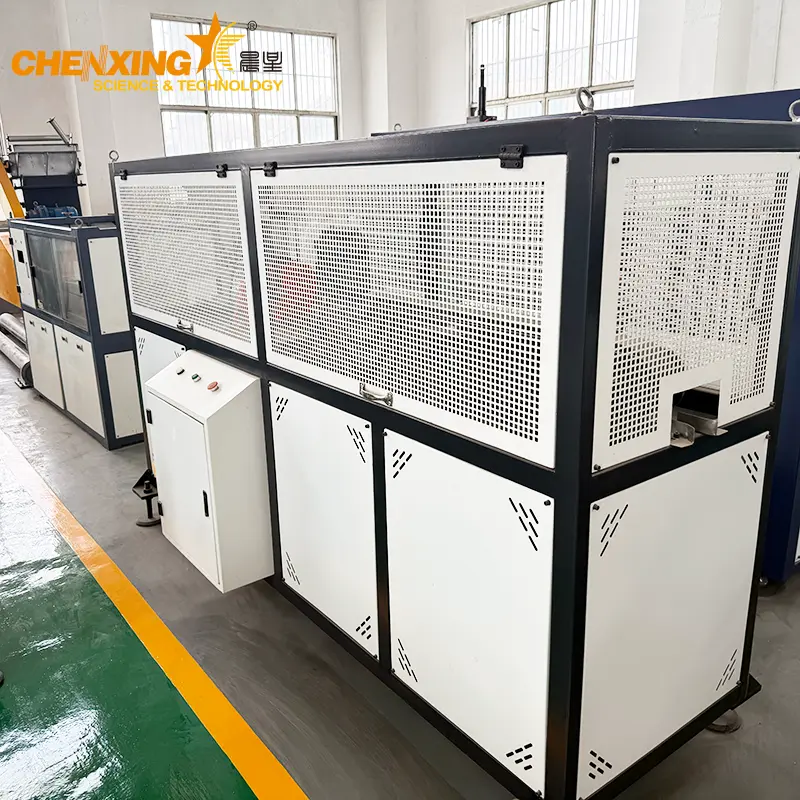
| 4 | Vacuum Calibration Table | 1 set | SUS304 stainless steel, multi-zone vacuum with independent pressure regulation, precision-ground sizing plates, rapid water cooling circuit (15–20°C) |
| 5 | Haul-off Machine | 1 set | AC servo or frequency-controlled drive, rubber grip rollers/belts, pneumatic clamping, synchronized speed with extruder |
| 6 | Automatic Cutting Machine | 1 set | Circular saw or guillotine type, pneumatic clamping, encoder-based length counting, cut accuracy ±1 mm |
| 7 | Stacker | 1 set | Pneumatic tilting table, length-adjustable collection rack |
| # | Machine | Qty | Key Specifications |
|---|---|---|---|
| 8 | High-Speed Mixer | 1 set | SRL-Z series, 200/500 or 300/600 configuration; for PVC dry blend preparation (resin + CaCO₃ + stabilizer + additives) |
| 9 | Hot Stamping Machine | 1 set | On-line integration; silicone roller 180–220°C; foil feed mechanism; applies woodgrain, marble, or solid-color patterns during extrusion; foil width up to 400 mm; foil change ≤5 min |
| 10 | Laminating Machine | 1 set | Off-line station; cold or hot lamination; applies decorative PVC film, PET film, or PMMA film with uniform pressure rollers; suitable for metallic finishes and high-gloss surfaces |
| 11 | Crusher (SWP Series) | 1 set | For edge trim and off-spec panel size reduction |
| 12 | Pulverizer (SMP Series) | 1 set | Reduces crushed material to <2 mm regrind powder for closed-loop recycling |
One extruder, multiple products. Switch between ceiling panels (100–600 mm width), wall panels, U-clips, flooring planks, and decorative trim profiles by replacing the die head and calibration tooling. With an experienced crew, a complete product changeover takes approximately 2–3 hours — transforming a single capital investment into a multi-category production platform.
The 38CrMoAlA nitrided steel screw pair is machined on CNC screw millers to precise intermeshing geometry. Its variable pitch and progressively decreasing channel depth deliver gentle shear and superior plasticizing for PVC formulations containing up to 30–50 phr CaCO₃ filler loading. The result is consistent gelation uniformity, ensuring stable panel density and a flawless surface finish across continuous production runs.
Barrel temperature is maintained within ±1°C via a PID-controlled oil cooling circuit combined with forced-air fans. Oversized heat exchangers prevent thermal runaway during extended high-output runs. This dual cooling architecture eliminates the hot spots that cause discoloration and embrittlement in calcium-carbonate-filled PVC — a common failure mode in single-cooling extruders.
A silicone roller transfer station operating at 180–220°C applies woodgrain, marble, or solid-color decorative patterns directly onto the panel surface during extrusion. This eliminates the need for a separate off-line finishing step, reducing labor, floor space, and handling damage. Pattern width accommodates up to 400 mm, and foil roll changeover takes under 5 minutes, keeping downtime minimal.
For wider panels or thicker decorative films (PVC, PET, PMMA) that exceed hot stamping foil width or temperature limits, a standalone laminating station applies cold or heat-activated film with uniform pressure rollers. This route enables metallic finishes, high-gloss surfaces, and low-temperature-sensitive decorative materials — at the cost of one additional off-line station and 1–2 extra operators.
Edge trim from the cutting station is routed to an SWP-series crusher and SMP-series pulverizer, reducing waste to <2 mm powder. The regrind is reintroduced into the extruder feed at up to 10–15% regrind ratio without compromising panel mechanical properties — turning what would be disposal cost into raw material savings.
Siemens PLC control with touchscreen HMI provides centralized monitoring and recipe management. ABB/Vacon inverters drive all motors with precise speed regulation. Imported thrust bearings in the distribution gearbox are rated for 50,000+ hours under full extrusion back-pressure. A multi-point alarm system continuously monitors motor current, barrel temperature, melt pressure, and vacuum level — flagging anomalies before they become production stoppages.
Dry Blend Preparation: PVC resin, CaCO₃ filler, stabilizer, impact modifier, and processing aids are compounded in a high-speed mixer (SRL-Z series) to a homogeneous dry blend.
Extrusion: The dry blend is fed via variable-speed screw feeder into the SJSZ conical twin-screw extruder. Multi-zone barrel heating (155–190°C) plasticizes and homogenizes the melt, which exits through the sheet/profile die head as a flat panel.
Vacuum Calibration & Cooling: The hot panel enters the SUS304 vacuum calibration table, where multi-zone vacuum (independently regulated) and 15–20°C cooling water precision-size the panel to target thickness and width.
On-Line Hot Stamping: The panel surface passes through the hot stamping station, where a silicone roller at 180–220°C transfers decorative woodgrain, marble, or solid-color patterns from foil onto the panel surface in a single continuous step.
Haul-Off & Cutting: A servo-driven haul-off machine pulls the decorated panel at synchronized speed. The automatic cutting saw (encoder length-counting) cuts panels to preset length with ±1 mm accuracy.
Stacking & QC: The pneumatic stacker collects finished panels. QC inspects color uniformity, pattern alignment, and dimensional tolerance before packaging.
Dry Blend Preparation: Same as Route A.
Extrusion: Same as Route A.
Vacuum Calibration & Cooling: Same as Route A.
Haul-Off & Cutting: The bare panel exits calibration, passes through haul-off, and is cut to length. A transfer table conveys cut panels to the laminating station.
Off-Line Lamination: The laminating machine applies decorative PVC, PET, or PMMA film via cold or hot roller press, achieving uniform bonding across the full panel surface.
Stacking & QC: The stacker collects laminated panels. QC inspects lamination bond quality, surface finish, and dimensional accuracy before packaging.
Edge trim and off-spec panels → SWP Crusher → SMP Pulverizer → <2 mm regrind powder → reintroduced into extruder feed at 10–15%.
The four SJSZ models collectively cover a panel width range of 100–600 mm with a thickness tolerance of ±0.1 mm. The maximum achievable width is constrained by three factors: die lip adjustment precision, melt strength of the PVC formulation (higher CaCO₃ loading reduces melt elasticity and limits width), and vacuum uniformity across the calibration table. For consistent production of panels wider than 500 mm, the SJSZ80/156 model is required — its 6-meter calibration table provides sufficient residence time and its four 3.0 kW vacuum pumps deliver uniform negative pressure across the full width, preventing edge curling and center sag.
On-line hot stamping integrates decoration directly into the extrusion line, achieving higher throughput with no additional handling — but is limited to foil widths up to 400 mm and patterns that tolerate 180–220°C transfer temperatures. It is ideal for standard-width ceiling panels with woodgrain or marble patterns. Off-line lamination handles wider panels, metallic films, high-gloss PET/PMMA surfaces, and temperature-sensitive decorative materials that cannot withstand hot stamping heat. The trade-off is a separate off-line station requiring floor space and 1–2 extra operators. Many producers install both — hot stamping for volume products and lamination for premium/differentiated SKUs.
A single SJSZ extrusion line can produce at least five distinct product categories: ceiling panels, wall panels, U-clips (edge trim channels), flooring planks, and decorative trim profiles. Changeover involves swapping the die head and calibration tooling — a process that takes approximately 2–3 hours with a trained crew. For new profiles not previously run, the customer provides cross-section CAD drawings; Chenxing engineers the die head flow-channel geometry and precision-grinds the calibration sizing plates accordingly. Tooling fabrication lead time is 25–35 days, including trial-run validation and profile sample approval before shipment.
15+ Years of PVC Extrusion Expertise: Since our founding, Chenxing Machinery has focused exclusively on plastic extrusion equipment — we understand PVC rheology, formulation behavior, and tooling design at an engineering depth that general machinery suppliers cannot match.
End-to-End In-House Manufacturing: Screws, barrels, gearboxes, calibration tables, and haul-offs are all manufactured in our own facility. No outsourced critical components — this ensures quality traceability and short lead times for replacement parts.
Turnkey Project Delivery: From raw material formulation guidance to tooling design, installation, commissioning, and operator training — we deliver a production-ready line, not just a collection of machines.
Global After-Sales Support: Our service engineers are available for on-site installation and troubleshooting worldwide. Remote diagnostic support via video call is provided within 24 hours — minimizing your downtime.
Continuous Innovation: We invest 5–8% of annual revenue into R&D, with active development in energy-saving barrel heating technology, intelligent IoT-based production monitoring, and high-fill formulation processing — keeping our customers ahead of market trends.
Ready to launch or expand your PVC ceiling and wall panel manufacturing? Contact us today.
Step 1 — Inquiry: Send your panel width, thickness, output target, and desired surface finish (hot stamping or lamination) to ceo@cxsljx.com.
Step 2 — Consultation: Our engineers will recommend the optimal SJSZ model, tooling configuration, and auxiliary equipment tailored to your production goals, including a detailed quotation and factory layout proposal.
Step 3 — Confirmation: Upon order confirmation, we begin tooling fabrication (if custom profiles are required) and machine assembly. Regular progress updates with photos and videos are provided throughout the build.
Step 4 — Delivery & Commissioning: Equipment is shipped, installed, and commissioned by our service team. Operator training is conducted on-site to ensure your crew achieves full production capacity within the shortest ramp-up time.
Contact Nicole:
Phone WeChat WhatsApp: +8615951187228
Email: ceo@cxsljx.com
Company: Zhangjiagang Chenxing Machinery Co., Ltd.
Explore our full product catalog | Auxiliary machines | Solutions | Contact us


