


News&Blogs


India's plastic pipe industry stands at a historic inflection point. The convergence of the world's largest national water infrastructure program, accelerating urbanization, agricultural modernization, and a fundamental policy shift away from metal and concrete pipes is creating a demand environment unprecedented in the sector's history. The Indian plastic pipe market is projected to grow from USD 5.46 billion in FY2025 to USD 7.94 billion by FY2033, representing a compound annual growth rate of 4.80%—and many industry observers consider this a conservative estimate given the scale of ongoing and announced projects. With India's per capita plastic product consumption at just 13 kg/person/year—well below global averages—the long-term growth runway extends far beyond current projections. For global manufacturers of plastic pipe extrusion machinery, India represents one of the most significant equipment procurement markets worldwide over the next decade.Overview
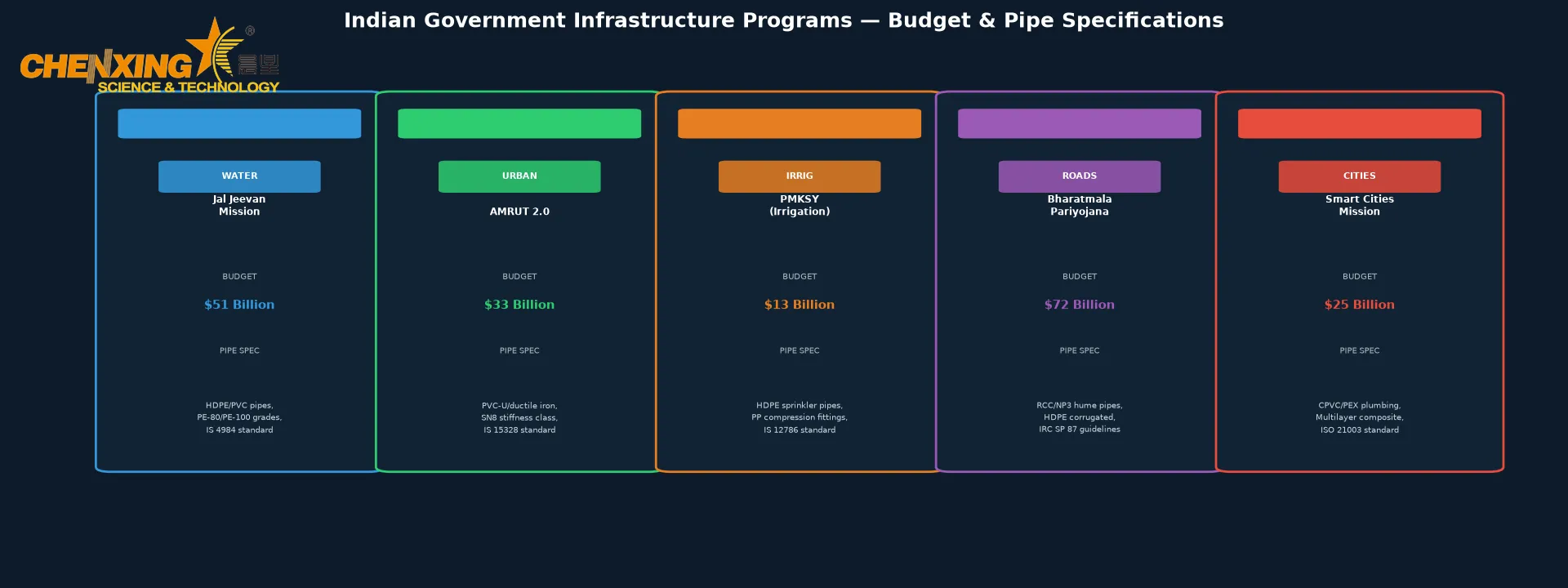
Extended to December 2028 with a total outlay of ₹8.69 lakh crore (approximately USD 104 billion), the Jal Jeevan Mission 2.0 is the largest water infrastructure program in global history. The program mandates piped water supply connections to every rural household in India. Over 15.44 crore (154.4 million) households have already been connected, with procurement continuing at volume through the extension period.
Every rural piped water supply scheme under the mission requires IS 4984:2016 BIS-certified HDPE pressure pipes. This single specification requirement has transformed India's HDPE pipe manufacturing landscape, driving demand for high-quality extrusion lines capable of producing BIS-compliant PE pipes across the full diameter range from DN20 to DN630 and beyond.
The Atal Mission for Rejuvenation and Urban Transformation (AMRUT) 2.0 is funding sewerage, drainage, and water supply upgrades across 500+ urban centers. The program specifies HDPE double-wall corrugated (DWC) pipes (IS 16098) for sewerage applications and HDPE pressure pipes for water distribution networks. These are replacing corroded galvanized iron and leaking concrete systems that have plagued Indian cities for decades.
Swachh Bharat Mission 2.0: Expanding sanitation infrastructure across urban and rural India, driving demand for PVC and HDPE drainage and sewer pipes.
Smart Cities Mission: Technology-integrated urban development across 100 cities, requiring advanced piping systems for water management, gas distribution, and telecommunications ducting.
PM Krishi Sinchayee Yojana: Agricultural irrigation expansion creating demand for HDPE and PVC pipes in micro-irrigation applications, with weather-resistant PP variants gaining traction.
HDPE pipes are at the center of India's infrastructure transformation. The material's combination of flexibility, corrosion resistance, 50-year design life, and compliance with BIS standards makes it the preferred choice across all major government programs. Key specifications driving procurement include:
IS 4984:2016 — HDPE pipes for potable water supply (pressure applications)
IS 14333:1996 — HDPE pipes for sewerage (non-pressure applications)
IS 16098 — Structured-wall HDPE pipes for underground drainage and sewerage
Manufacturers serving the Indian market must ensure their extrusion lines are capable of producing pipes that consistently meet these standards, including wall thickness tolerances, hydrostatic pressure testing requirements, and material certification protocols.
PVC pipes continue to dominate agriculture and building drainage applications where cost sensitivity is highest. However, the government's procurement specifications increasingly favor HDPE for municipal applications due to superior long-term performance characteristics and environmental considerations. PVC's market share is gradually declining in infrastructure applications while remaining strong in agricultural and residential segments.
PP-R pipes are gaining adoption in hot water and industrial fluid transport applications, while glass-fiber reinforced pipes are specified for select large-diameter infrastructure projects. These premium segments offer higher margins for manufacturers with the technical capability to produce them.
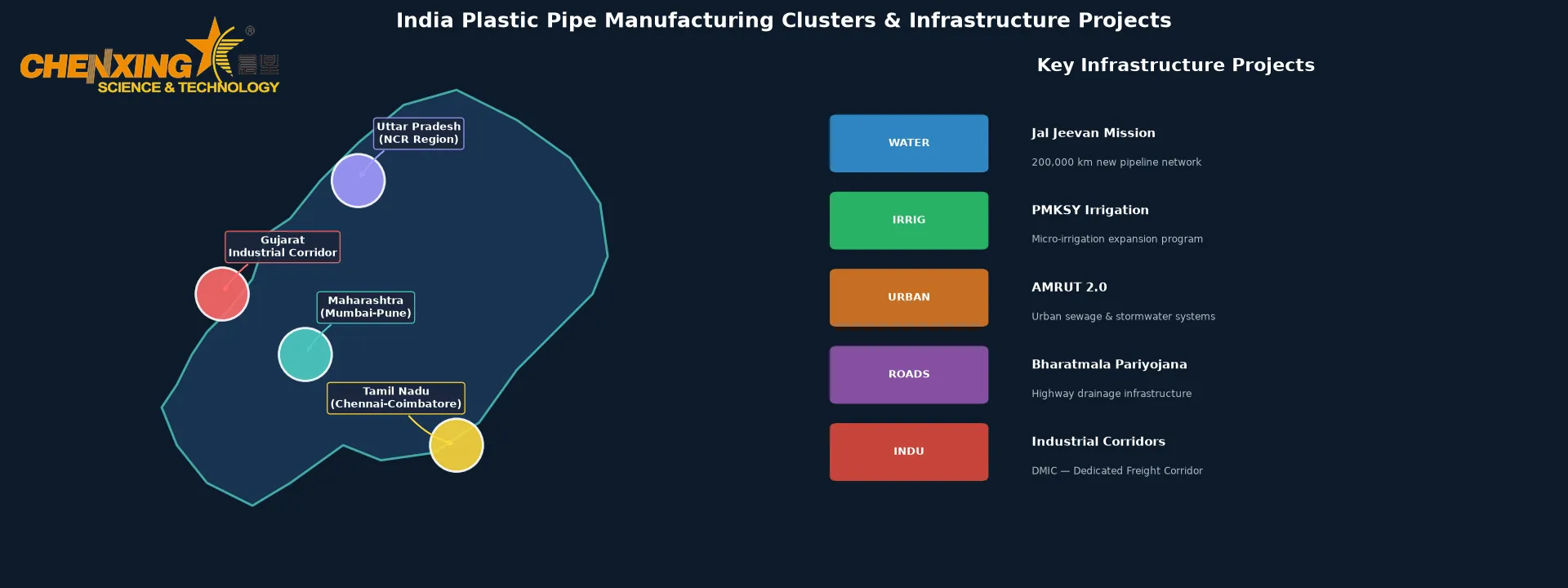
India's plastic pipe manufacturing capacity is heavily concentrated in the western industrial corridor spanning Gujarat and Maharashtra. This concentration has several implications for equipment suppliers:
Aggregated Demand: High-volume, price-sensitive procurement characterizes the region, favoring equipment suppliers who can offer competitive pricing with reliable after-sales service.
Cluster Effects: Technical knowledge sharing, skilled labor availability, and raw material supply chains are well-developed, reducing barriers to new manufacturing entrants.
Export Orientation: Gujarat's port infrastructure positions manufacturers for export markets in the Middle East and Africa, creating demand for multi-standard compliant extrusion lines.
The Bureau of Indian Standards (BIS) certification mandate is reshaping India's pipe manufacturing landscape. Key requirements include:
Mandatory BIS certification (ISI mark) for HDPE pipes used in potable water supply
ISO 14001:2015 environmental management system certification increasingly required for government tenders
Extended Producer Responsibility (EPR) compliance becoming a procurement criterion
100% recyclable material declarations gaining importance in tender documentation
For extrusion equipment suppliers, this means machinery must be capable of producing pipes that consistently meet BIS testing requirements. Traceability features—batch coding, material lot tracking, and quality parameter logging—are becoming essential selling points for extrusion lines targeting the Indian market.
The combination of new manufacturing capacity requirements and equipment replacement cycles (driven by BIS certification upgrades) is generating sustained demand for pipe extrusion lines. Key opportunity areas include:
HDPE Pipe Extrusion Lines (DN20-DN630): The highest-volume segment, driven by JJM 2.0 rural water supply requirements.
Large-Diameter HDPE Lines (DN630+): Urban water transmission and industrial applications.
DWC Pipe Production Lines: Growing demand from AMRUT 2.0 sewerage projects.
Multi-Layer and Co-Extrusion Lines: Premium applications in gas distribution and industrial piping.
Recycling-Integrated Lines: Equipment capable of incorporating PCR content as EPR requirements tighten.
The Indian extrusion equipment market is served by a mix of domestic manufacturers and international suppliers. Chinese manufacturers, particularly from Zhangjiagang—a major extrusion equipment hub—have a significant presence in the price-sensitive mid-market segment. Competitive differentiation increasingly depends on after-sales service quality, BIS compliance capability, and energy efficiency.
India's plastic pipe market is valued at approximately USD 5.46 billion in FY2025 and projected to reach USD 7.94 billion by FY2033, growing at a CAGR of 4.80%.
Five major government programs are simultaneously driving demand: Jal Jeevan Mission 2.0 (rural water supply), AMRUT 2.0 (urban infrastructure), Swachh Bharat Mission 2.0 (sanitation), Smart Cities Mission, and PM Krishi Sinchayee Yojana (irrigation).
HDPE pipes dominate government infrastructure procurement due to mandatory BIS certification requirements (IS 4984:2016) under the Jal Jeevan Mission. PVC remains strong in agricultural and cost-sensitive applications.
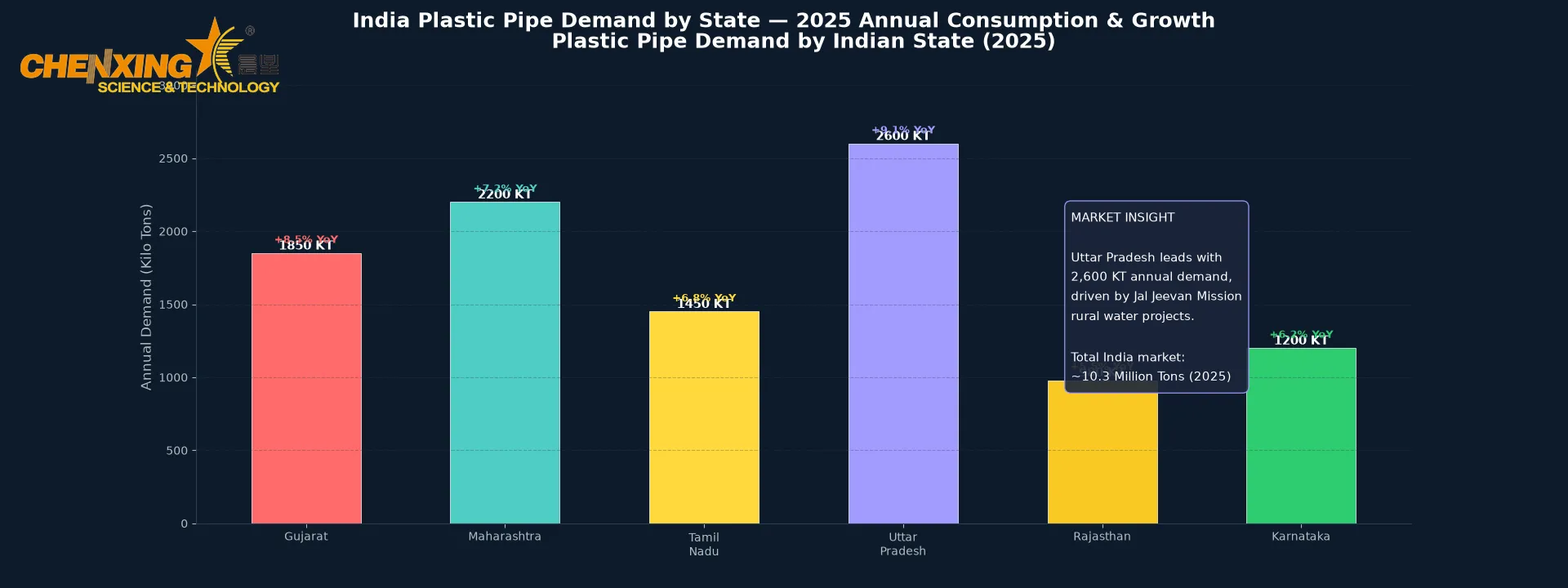
The primary manufacturing clusters are in Gujarat and Maharashtra, forming India's western industrial corridor. Tamil Nadu, Uttar Pradesh, and Rajasthan are secondary manufacturing hubs.
Key standards include IS 4984:2016 (HDPE for water supply), IS 14333 (HDPE for sewerage), IS 16098 (structured-wall HDPE pipes), and IS 13592 (PVC pipes). BIS certification (ISI mark) is mandatory for potable water supply pipes.
Significant opportunities exist in HDPE pipe extrusion lines for DN20-DN630 and DN630+ specifications, DWC pipe production lines, multi-layer co-extrusion systems, and recycling-integrated lines. Competitive pricing with reliable after-sales service is essential.


