


News&Blogs


On August 12, 2026, the European Union's Packaging and Packaging Waste Regulation (PPWR 2025/40) will enter full application, marking the most significant regulatory shift in packaging legislation in nearly three decades. Replacing the previous Packaging and Packaging Waste Directive (94/62/EC), the PPWR upgrades from a "directive"—requiring individual member state transposition—to a "regulation" with direct legal effect across all 27 EU member states. This eliminates regulatory fragmentation and creates a unified, stringent market access threshold for all packaging and packaged products entering the European Economic Area. For manufacturers of plastic pipes, fittings, packaging materials, and related products—particularly B2B exporters based in China, India, and other non-EU manufacturing hubs—the PPWR represents both a compliance challenge and a strategic opportunity. Early adopters who align their product portfolios with PPWR requirements will gain competitive advantage in the world's second-largest plastic products market.Overview
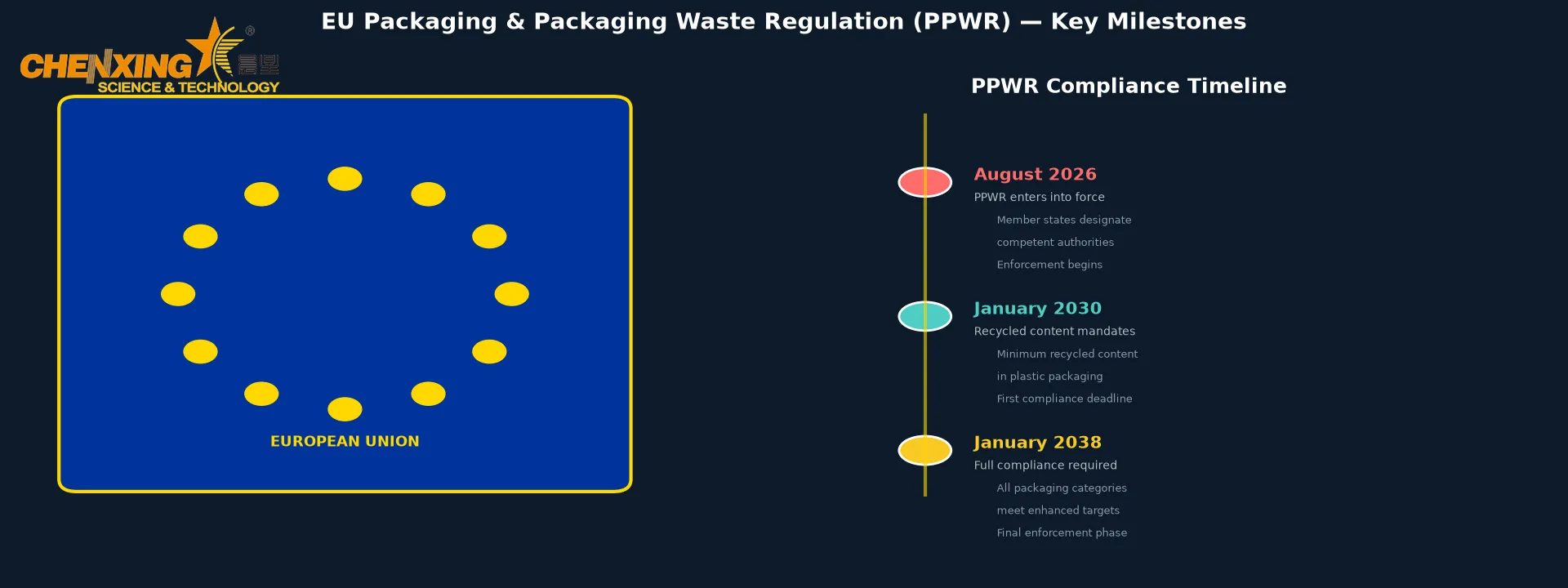
The PPWR applies to all economic operators placing packaging or packaged products on the EU market, regardless of sales channel (online or offline). Obligated parties include:
Manufacturers of packaging and packaged products
Importers bringing packaged goods into the EU
Distributors and retailers selling packaged products within the EU
Critically, the regulation covers all packaging materials—plastics, paper, metal, glass, and composites—across all application scenarios, including industrial, commercial, consumer, and logistics packaging. Imported products are equally subject to these requirements, meaning non-EU manufacturers must comply to maintain market access.
The shift from directive to regulation is not merely procedural—it is transformational. Under the previous directive, member states could interpret and implement requirements differently, creating varying compliance standards across borders. The PPWR, as a regulation, is directly applicable without national transposition, ensuring uniform enforcement. This means a single non-compliance finding in any EU port of entry can block market access across the entire bloc.
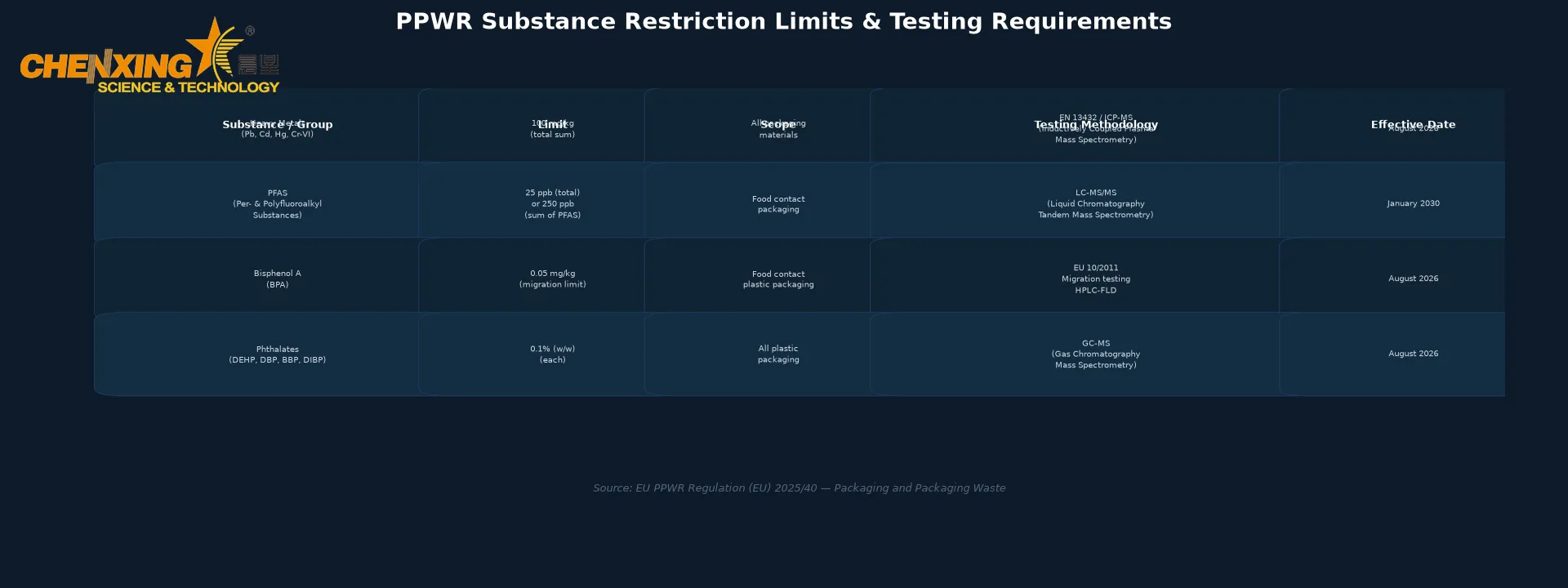
Effective from August 12, 2026, the PPWR imposes strict substance limitations:
Heavy Metals: The sum of lead, cadmium, mercury, and hexavalent chromium must not exceed 100 mg/kg in any packaging or packaging component. This applies uniformly across all material types.
PFAS in Food-Contact Packaging: For packaging intended for food contact, specific PFAS limits apply:
Individual non-polymeric PFAS: ≤25 ppb
Sum of all non-polymeric PFAS: ≤250 ppb
Total fluorine content (indicating polymeric PFAS): ≤50 ppm, with a requirement to provide technical documentation if exceeded
For plastic pipe and fitting manufacturers, these substance restrictions extend to all packaging used to ship products into the EU market. This includes pallet wrapping, protective packaging, boxes, and any labeling materials.
The PPWR mandates that all packaging placed on the EU market must be recyclable, with performance graded on a recyclability scale:
From January 1, 2030: All packaging must achieve recyclability grades A, B, or C. Packaging with Design for Recycling (DfR) performance below 70% is deemed "technically non-recyclable" and prohibited from the EU market.
From January 1, 2038: Only packaging achieving grades A or B will be permitted.
This "design for recycling" principle has profound implications for plastic product manufacturers. Multi-layer packaging, certain colorants, incompatible material combinations, and hard-to-separate components may render products non-compliant under the new grading system. Manufacturers should begin evaluating their packaging designs against the DfR criteria now to ensure 2030 compliance.
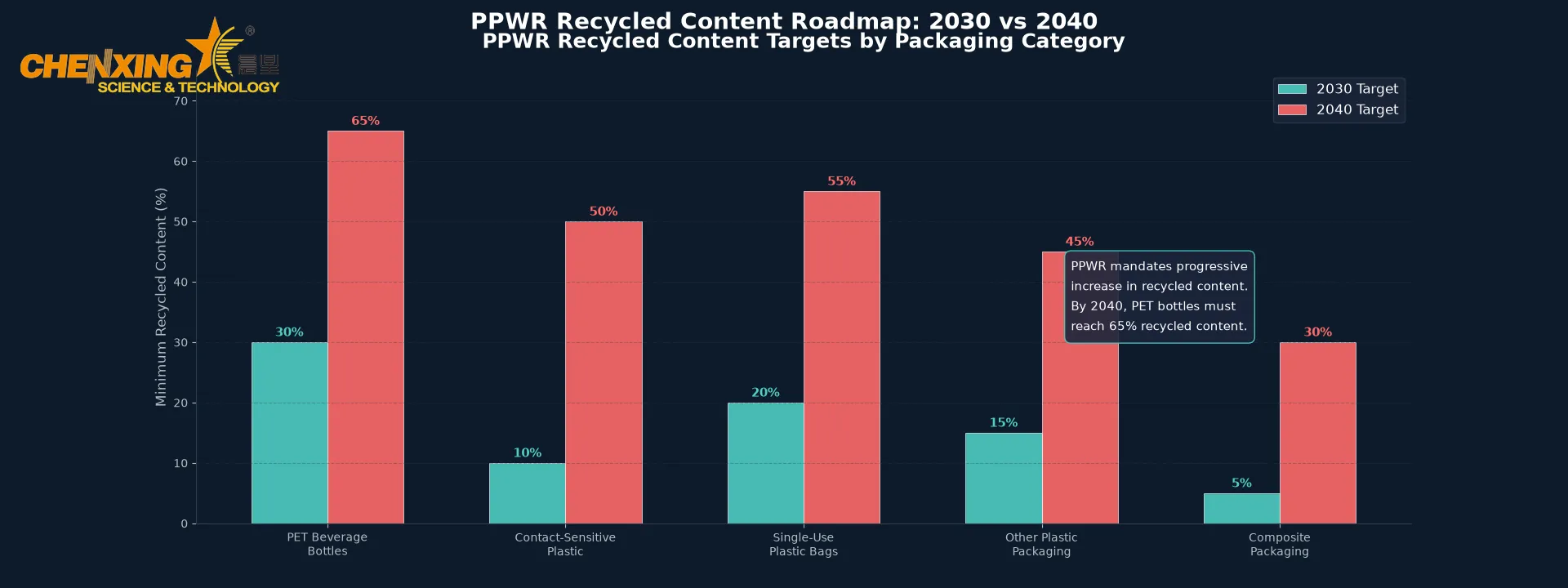
Perhaps the most impactful requirement for the plastics industry is the mandatory recycled content minimums for plastic packaging. These are phased targets with escalating requirements:
| Packaging Category | 2030 Target | 2040 Target |
|---|---|---|
| Single-use plastic beverage bottles | ≥30% recycled content | ≥65% recycled content |
| PET contact-sensitive packaging (excluding single-use bottles) | ≥30% | ≥50% |
| Non-PET contact-sensitive packaging (excluding single-use bottles) | ≥10% | ≥25% |
| All other plastic packaging | ≥35% | ≥65% |
These mandates are driving explosive growth in the recycled plastics market, which is projected to grow from USD 70.3 billion in 2026 to USD 131.0 billion by 2033 at a 9.3% CAGR. For pipe and fitting manufacturers supplying the EU market, integrating post-consumer recycled (PCR) content into product formulations is becoming a competitive necessity, not merely an environmental preference.
The 2030 and 2040 recycled content mandates create massive demand for plastic recycling machinery—washing lines, shredders, granulators, and extrusion systems capable of processing PCR materials while maintaining product quality. For equipment manufacturers, this represents a multi-decade growth opportunity as the global plastics industry retools for circular production.
Manufacturers who can demonstrate compliance with PPWR requirements through third-party certification will command premium positioning in the EU market. This includes providing detailed technical documentation on material composition, recycled content verification, and recyclability assessments.
The DfR grading system strongly favors mono-material packaging designs that simplify recycling streams. Plastic pipe manufacturers using single-polymer packaging solutions (e.g., all-PE protective wrapping) will find easier paths to A/B recyclability grades than those using multi-material composites.
The direct applicability of PPWR as a regulation means non-compliant products face immediate market exclusion across all 27 EU member states simultaneously. The cost of non-compliance far exceeds the investment required for compliance, particularly given the 2030-2040 phased approach that allows for gradual adaptation.
The PPWR (Regulation 2025/40) enters full application on August 12, 2026. Substance restrictions for heavy metals and PFAS in food-contact packaging take effect immediately on that date.
Yes. The PPWR covers all packaging regardless of application context—industrial, commercial, consumer, and logistics packaging are all within scope. There are no blanket exemptions for B2B or industrial use cases.
From 2030, packaging with Design for Recycling (DfR) performance below 70% (grade D or lower) is deemed "technically non-recyclable" and prohibited from the EU market. From 2038, only grades A and B are permitted. Non-compliant products face market exclusion across all EU member states.
Non-EU manufacturers must work with EU-based authorized representatives or importers who bear compliance responsibility. Documentation requirements include material composition declarations, recycled content verification, recyclability assessments, and substance restriction test reports from accredited laboratories.
The previous directive (94/62/EC) required individual EU member state transposition, creating regulatory fragmentation. PPWR is a regulation with direct legal effect—uniform requirements, uniform enforcement, no national variation. This makes compliance simpler to understand but stricter in application.
All packaging used to ship plastic pipes and fittings into the EU must comply with PPWR requirements. This includes pallet wrapping, protective materials, boxes, and labels. Additionally, if the pipes or fittings themselves are considered "packaging" in certain applications, product-level recycled content requirements may apply.


